
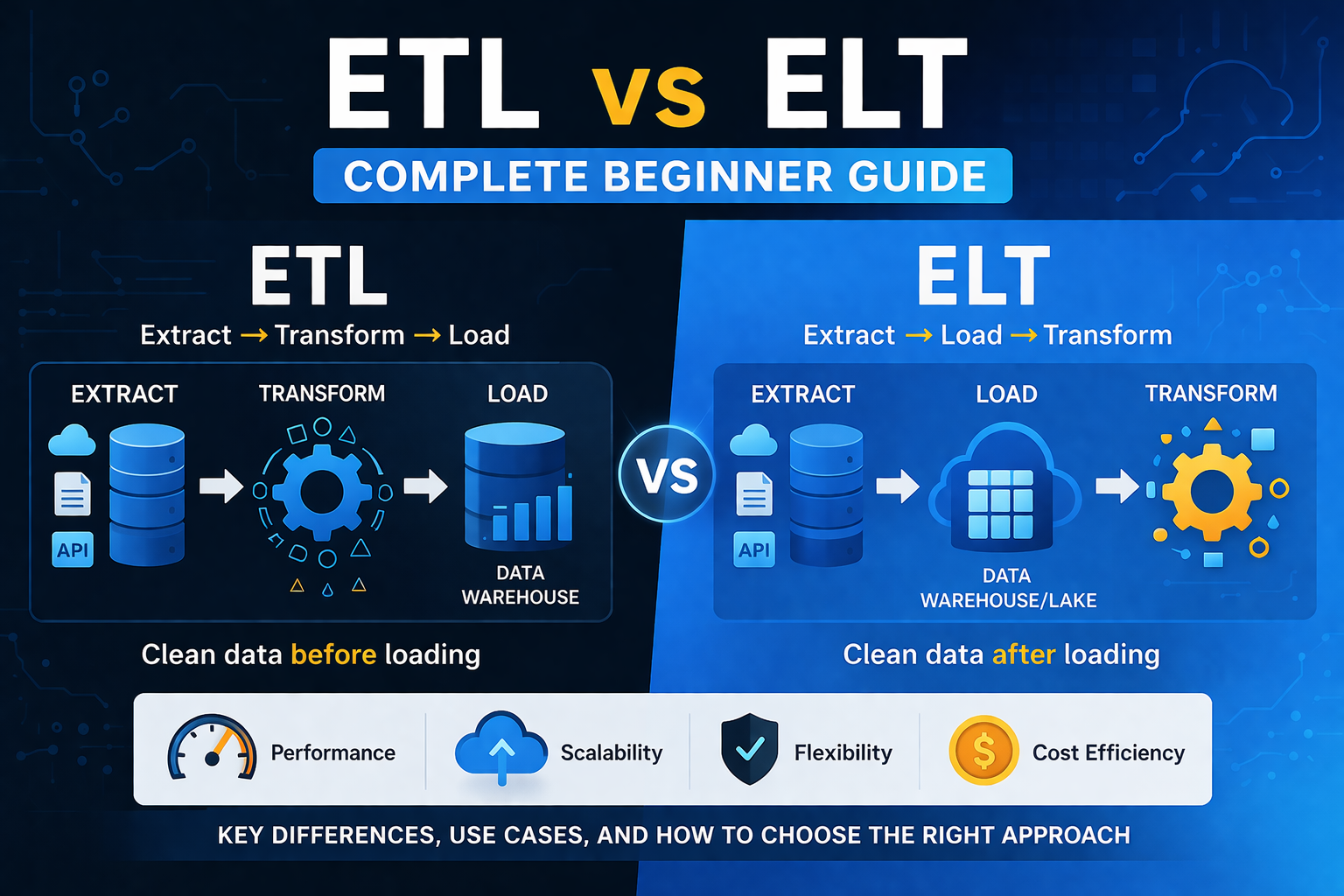
ETL vs ELT! In today’s data-driven economy, businesses generate massive amounts of data from apps, websites, sensors, and customer interactions. But raw data alone is not useful. It needs to be cleaned, organized, and transformed into insights. That’s where ETL and ELT come in.
If you’re new to data analytics, data engineering, or business intelligence, understanding the difference between ETL and ELT is one of the most important foundations you can build.
This guide breaks it down in a simple, practical, and deeply explained way so you don’t just memorize it, you actually understand it.
What Are ETL and ELT (In Simple Terms)?
Both ETL (Extract, Transform, Load) and ELT (Extract, Load, Transform) are methods used to move data from multiple sources into a central system like a data warehouse or data lake.
The core difference is when and where the data is transformed.
- ETL → Clean first, then store
- ELT → Store first, then clean
That small difference changes everything from speed to cost to scalability.
Understanding ETL (Traditional Approach)
How ETL Works
ETL follows a structured pipeline:
- Extract – Data is collected from sources (databases, APIs, files)
- Transform – Data is cleaned, formatted, filtered, and structured
- Load – The clean data is stored in a warehouse
In ETL, transformation happens before the data reaches the destination.
Why ETL Was Created
ETL became popular when:
- Storage was expensive
- Processing power was limited
- Data was mostly structured (tables, rows, columns)
So companies preferred to clean data before storing it to save space and ensure quality.
Strengths of ETL
1. High Data Quality from the Start
Data is cleaned before storage, reducing errors and inconsistencies.
2. Strong Compliance & Security
Sensitive data can be masked or removed before it reaches storage.
3. Ideal for Structured Data
Works well with traditional relational databases.
4. Controlled Environment
Everything is processed through defined rules before use.
Limitations of ETL
- Slower for large datasets (due to heavy pre-processing)
- Less flexible (you lose raw data)
- Requires additional infrastructure for transformation
Understanding ELT (Modern Approach)
How ELT Works
ELT flips the process:
- Extract – Data is collected
- Load – Raw data is stored immediately
- Transform – Data is processed inside the warehouse
In ELT, transformation happens after the data is stored, using the power of modern systems.
Why ELT Became Popular
ELT emerged because of:
- Cloud computing
- Cheap storage
- Powerful data warehouses (like Snowflake, BigQuery)
Instead of cleaning data early, companies now store everything first and decide later what to transform.
Strengths of ELT
1. Speed & Performance
Data loads faster because transformation doesn’t slow ingestion.
2. Scalability
Handles massive datasets (big data, real-time streams).
3. Flexibility
You keep raw data, so you can reprocess it anytime.
4. Cost Efficiency (Cloud-Based)
Pay-as-you-go models reduce upfront costs.
Limitations of ELT
- Raw data can be messy initially
- Requires powerful cloud infrastructure
- Governance can become complex if unmanaged
ETL vs ELT: The Real Difference
Here’s the most important takeaway:
👉 ETL = Transform outside the warehouse
👉 ELT = Transform inside the warehouse
Everything else (speed, cost, scalability) comes from that one difference.
Side-by-Side Comparison
| Feature | ETL | ELT |
|---|---|---|
| Process Order | Extract → Transform → Load | Extract → Load → Transform |
| Data Storage | Only cleaned data | Raw + cleaned data |
| Speed | Slower for large data | Faster ingestion |
| Flexibility | Low | High |
| Best For | Structured data | Big data & cloud systems |
| Infrastructure | Separate processing tools | Uses warehouse power |
| Data Types | Mostly structured | Structured + unstructured |
ETL focuses on precision first, while ELT focuses on speed and flexibility first.
When Should You Use ETL?
Choose ETL if:
- You need clean, reliable data before storage
- You work in regulated industries (finance, healthcare)
- Your data is mostly structured
- You use traditional/on-premise systems
ETL is still widely used because it ensures data integrity from the beginning.
When Should You Use ELT?
Choose ELT if:
- You use cloud data warehouses
- You handle large or real-time data
- You need flexibility for analytics
- You want faster data ingestion
ELT is ideal for modern companies dealing with big data and rapid decision-making.
Real-World Example (Easy to Understand)
Imagine an Online Store:
ETL Approach:
- Collect sales data
- Clean and format it
- Store only the final version
👉 Result: Clean but limited data
ELT Approach:
- Collect all raw sales data
- Store everything
- Analyze and transform later
👉 Result: More flexible insights (you can re-analyze anytime)
Modern Trend: ELT is Growing, But ETL Still Matters
Today, ELT is becoming more popular because of cloud technologies and scalability.
However, ETL is far from obsolete.
In fact, many companies use a hybrid approach:
- ETL for sensitive or structured data
- ELT for large-scale analytics
Common Beginner Mistakes
❌ “ELT is better than ETL”
Not true. Each serves different needs.
❌ “They are completely different systems”
They use the same steps just in a different order.
❌ “You must choose one”
Modern systems often use both.
Best Practices for Beginners
- Start simple, don’t over-engineer pipelines
- Understand your data type and volume
- Prioritize data quality and governance
- Use tools that match your infrastructure (cloud vs on-premise)
- Always document your pipeline
Final Thoughts
ETL and ELT are not competing ideas; they are evolutionary approaches to the same problem: making data useful.
- ETL gives you control, structure, and reliability
- ELT gives you speed, scale, and flexibility
If you’re just starting out, focus on understanding this one principle:
👉 Where does the transformation happen?
Once you understand that, everything else about ETL vs ELT becomes much easier.
Frequently Asked Questions (FAQs)
What is the main difference between ETL and ELT?
The main difference between ETL and ELT is when the transformation happens. ETL transforms data before loading it into the data warehouse, while ELT loads raw data first and transforms it afterward within the warehouse.
Which is better: ETL or ELT?
Neither is universally better. ETL is ideal for structured data and strict data quality requirements, while ELT is better suited for large-scale, cloud-based data processing and analytics.
Is ELT faster than ETL?
Yes, ELT is generally faster because it loads data immediately and uses the processing power of modern cloud data warehouses for transformation.
When should I use ETL instead of ELT?
You should use ETL when data quality, security, and compliance are critical, especially in industries like finance and healthcare where data must be cleaned before storage.
When should I use ELT instead of ETL?
ELT is best used when working with large volumes of data, cloud platforms, and when flexibility is required for advanced analytics and experimentation.
Can ETL and ELT be used together?
Yes, many modern data architectures use a hybrid approach, combining ETL for sensitive or structured data and ELT for large-scale analytics and flexibility.
What tools are used for ETL and ELT?
Common ETL tools include SSIS, Informatica, and Talend. ELT tools include Fivetran, Stitch, dbt, and Apache Airflow.
Is ETL still relevant today?
Yes, ETL remains relevant, especially in environments that require strict data governance, structured data processing, and compliance with regulations.
What is a data pipeline in ETL and ELT?
A data pipeline is a series of processes that move data from source systems to a destination, transforming it along the way depending on whether ETL or ELT is used.
Does ELT require cloud computing?
While not mandatory, ELT is most effective when used with cloud-based data warehouses that provide scalable processing power.